.png)

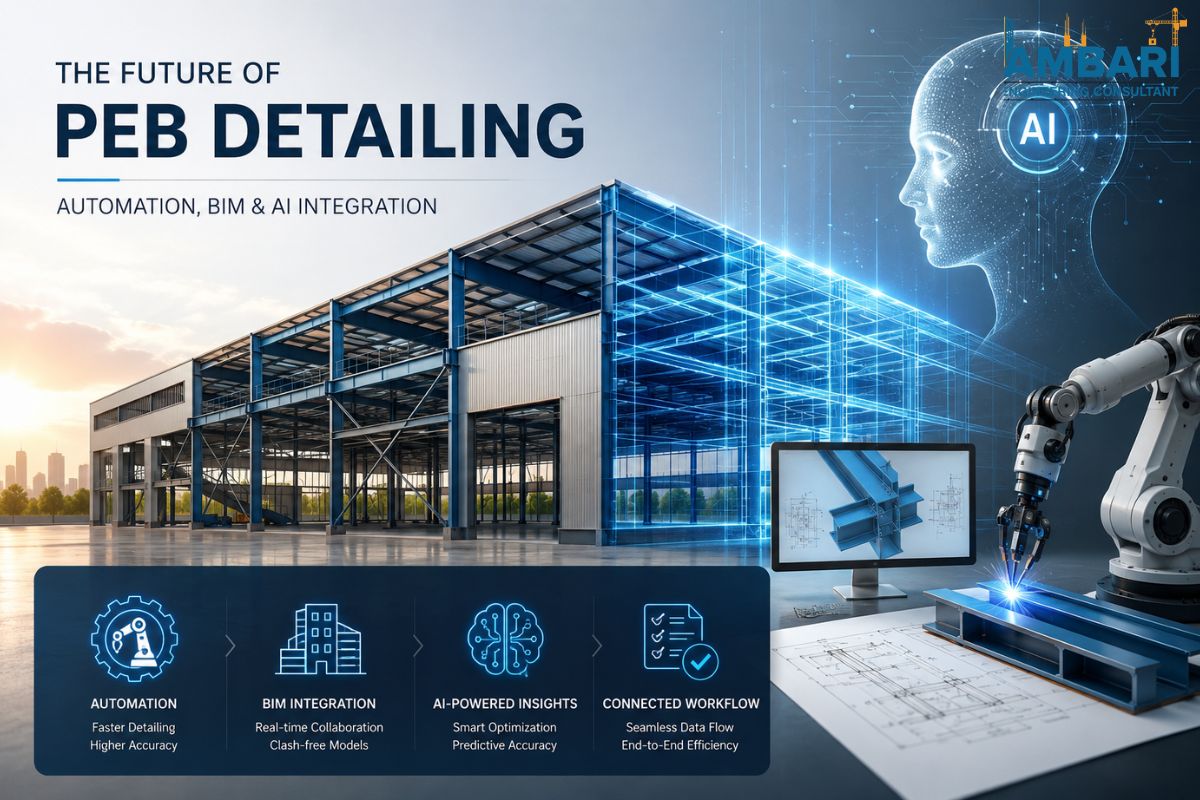
Automation, Building Information Modeling (BIM), and Artificial Intelligence (AI) are influencing the future of PEB design and detailing services. These innovations are enabling engineers, fabricators, and construction companies to increase accuracy, cut project timelines, and lower costs. With the ever-increasing need for speed in project delivery in industries, modern PEB detailing services are moving beyond traditional drafting methods and adopting intelligent workflows driven by data.
In India and globally, companies that adopt automation, BIM, and AI are gaining a competitive advantage by delivering high-quality pre-engineered building projects with fewer errors, improved coordination, and greater overall efficiency.
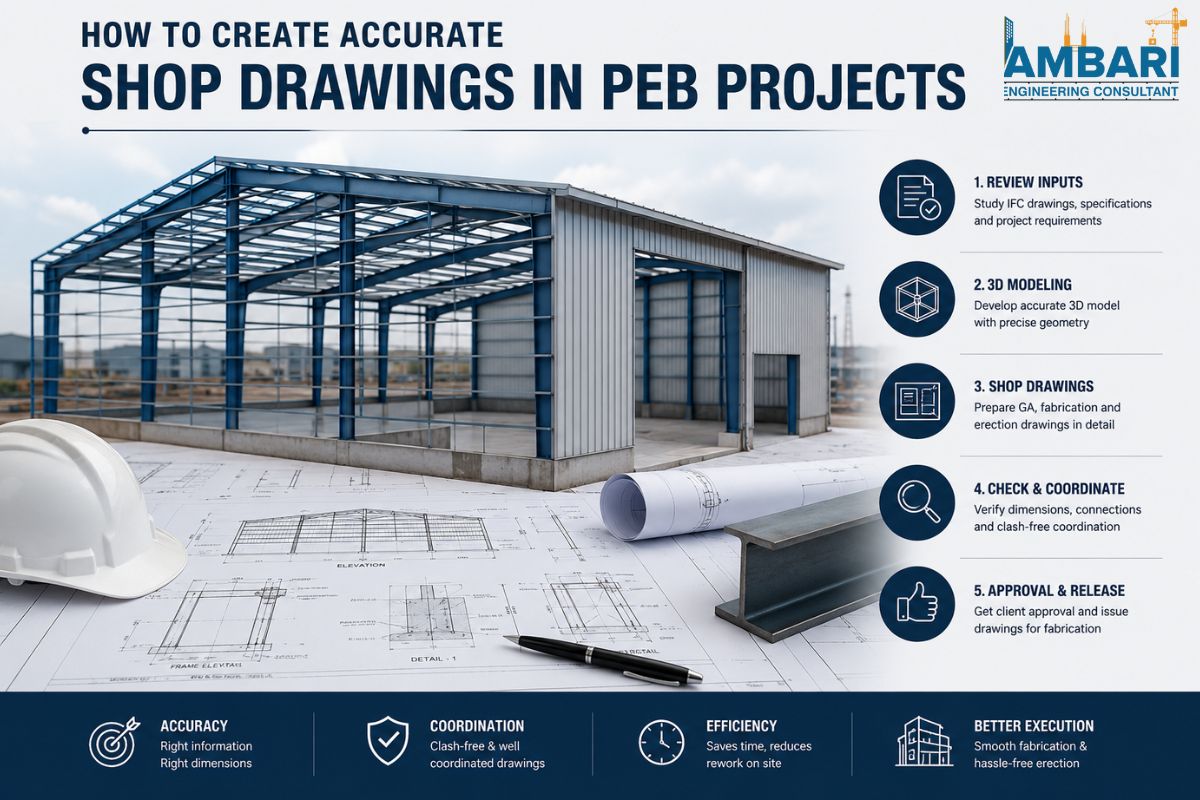
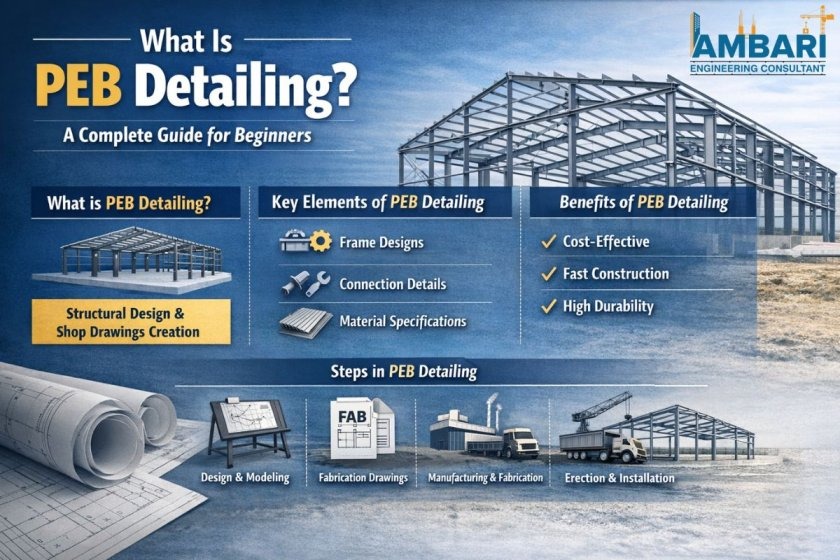
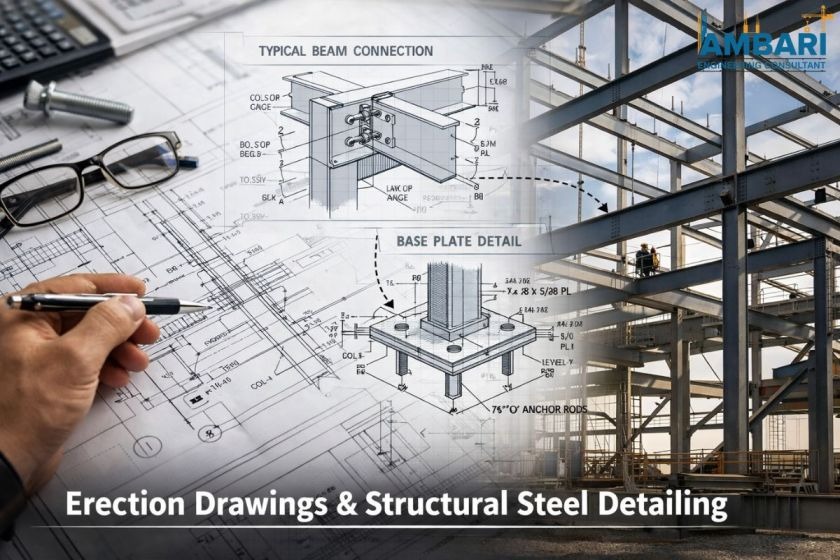
The detailed fabrication and erection drawings of pre-engineered buildings are created in the PEB Structure Detailing. These drawings include:
Modern PEB detailing goes far beyond traditional drafting practices. Today, advanced digital technologies are integrated into the detailing process to improve accuracy, streamline workflows, and enhance collaboration between designers, fabricators, and construction teams. This technology-driven approach helps reduce errors, improve project coordination, and support faster project delivery.
The construction industry is facing several challenges that demand faster, more accurate, and more efficient project delivery. These challenges include:
To overcome these challenges, companies are increasingly investing in advanced PEB Design Detailing Services that improve accuracy, streamline workflows, and accelerate project execution.
Today, technology is no longer an optional advantage in PEB projects—it has become a necessity for achieving successful project outcomes and maintaining a competitive edge in the construction industry.
Automation tools can generate repetitive detailing components automatically, significantly reducing the time required for manual drafting and drawing preparation.
Automated workflows help minimize manual errors related to dimensions, member positioning, and connection details, resulting in higher-quality drawings.
Advanced detailing software can produce fabrication-ready drawings, reports, and material information directly, helping manufacturers avoid production delays and improve efficiency.
By automating repetitive tasks, engineering teams can focus more on complex design challenges and value-added activities, improving overall project productivity.
Leading companies such as Ambari Consultant leverage automation technologies to handle large-scale projects more efficiently while maintaining high standards of detailing accuracy and quality.
Building Information Modeling (BIM) is a digital representation of a building’s physical and functional characteristics. It creates a centralized model that allows architects, engineers, fabricators, and construction teams to collaborate in real time throughout the project lifecycle.
BIM identifies conflicts between structural, architectural, and MEP systems during the design stage, helping teams resolve issues before construction begins.
Since all project stakeholders work from a shared model, communication improves and the risk of coordination errors is significantly reduced.
Material quantities can be extracted directly from the BIM model, supporting accurate procurement planning and cost estimation.
BIM provides valuable information for future maintenance, renovations, and facility management throughout the building's lifecycle.
Therefore, BIM has emerged as a crucial element in today's Pre Engineered Building Design India schemes.
Artificial Intelligence is bringing new levels of intelligence and automation to engineering and detailing processes.
AI can analyze multiple design alternatives and recommend the most efficient structural solutions based on project requirements.
Machine learning algorithms can identify potential drawing inconsistencies and design errors before fabrication begins.
AI-powered systems can verify drawings against engineering standards, project specifications, and industry codes to improve quality control.
AI helps optimize steel utilization and material planning, reducing waste and improving overall project profitability.
Forward-thinking companies such as Ambari Consultant are increasingly leveraging AI technologies to enhance engineering accuracy, streamline workflows, and improve project performance.
The greatest advantages are achieved when automation, BIM, and AI are integrated into a single workflow.
| Benefit | Impact |
|---|---|
| Faster Project Delivery | Reduced detailing and review time |
| Better Accuracy | Fewer design and fabrication errors |
| Cost Savings | Lower rework costs and reduced material wastage |
| Improved Collaboration | Better communication and coordination across teams |
| Enhanced Quality | Consistent detailing standards and improved accuracy |
| Higher Productivity | More projects completed efficiently with fewer resources |
Moreover, the value of these benefits makes advanced PEB detailing services more and more relevant for industrial, commercial and infrastructure projects.
Consider a large industrial warehouse project involving thousands of steel components and multiple engineering disciplines. Traditional construction workflows often face coordination challenges between structural and MEP systems, resulting in site modifications, project delays, and additional costs.
By implementing BIM-driven PEB Structure Detailing, the project team was able to identify and resolve clashes during the design stage before construction began. AI-powered quantity extraction improved procurement planning, while automated drawing validation helped eliminate inconsistencies and detailing errors.
The result was:
This example highlights why technology-driven detailing solutions are rapidly becoming the industry standard for modern pre-engineered building projects.
PEB Design and Detailing Services are moving towards becoming more intelligent, connected and efficient. Reducing repetitive work, improving collaboration through BIM and smarter decision making with AI. The more complex the construction project, the greater the benefits of using these technologies will be in terms of project outcomes, productivity and cost efficiency.
In recognition that digital transformation is becoming increasingly vital to engineering workflows, Ambari Consultant recognizes the need to keep these topics relevant. Incorporating innovation in PEB Detailing Services will equip companies to meet industry needs and execute projects with precision, efficiency, and confidence.
As you enter on your next pre-engineered building project, working with experts such as Ambari Consultant can ensure you reap the benefits of the most recent developments in pre-engineered building detailing for long-term success.
PEB Design and Detailing Services involve the preparation of structural designs, fabrication drawings, connection details, material information, and erection plans required for the successful construction of pre-engineered buildings.
BIM improves project coordination by enabling clash detection, visualization, quantity estimation, and collaboration among all project stakeholders before construction begins.
No. AI is designed to support engineers and detailers by automating repetitive tasks, improving accuracy, and assisting with decision-making. Human expertise remains essential for engineering judgment and project execution.
Automation helps reduce manual work, improve drawing accuracy, accelerate project delivery, and enhance overall productivity throughout the detailing process.
The future of Pre Engineered Building Design India will be driven by digital engineering, BIM collaboration, AI-powered design optimization, automation, and smart fabrication technologies that improve efficiency, quality, and project performance.