How Is Pre-Cast Concrete Manufactured and Installed?
Key takeaways
- Pre-cast concrete is produced on a factory scale for improved quality.
- Steel-reinforced and accurate molds provide strong and long-lasting pre-cast components.
- The installation process is faster and more efficient, resulting in significant labor cost savings.
- Pre-cast concrete is known for the flexibility it provides in construction.
Precast concrete is an option that has gained popularity in the construction industry today because of its durability, efficiency, and versatility. This concrete is now used in many construction projects due to the speed of construction, lower cost of labor, and quality assurance. whether it is for residential, commercial, or industrial buildings this is a perfect solution.
In this blog, we will discuss the production and installation of precast concrete in a simplistic manner. Additionally, we are going to talk about such services as structural engineering and drafting and detailing services in India, which contribute to the quality of precast structures
What is pre-cast concrete?
Precast concrete is concrete that is cast and cured under a controlled environment and then moved to the construction site to be installed. Precast elements are manufactured in factories; unlike traditional concrete that is poured and allowed to cure on-site, this gives the manufacturer control over the quality and strength of the concrete.
The most common pre-cast elements include:
- Beams and columns
- Floor slabs
- Wall panels
- Staircases
- Pipes and culverts
Manufacturing process of pre-cast concrete
The production of precast concrete is based on a number of steps, which are closely monitored:
-
Design and planning
Engineers and architects make elaborate designs before production commences. This involves computation of load-bearing capacity, dimensions, and the kind of reinforcement needed. In this case, structural engineering services in India are significant in the process of making sure that the elements are safe and durable
-
Preparing molds
The concrete elements are molded using molds, which are also referred to as forms. They are typically made of steel or timber and coated with a release agent to prevent sticking of concrete. This stage is usually accompanied by drafting and detailing services in India so that precise drawings are drawn to be followed in the manufacturing of the molds.
-
Mixing Concrete
Concrete is made by combining cement, aggregates, sand, and water in precise ratios. Admixtures may be added to improve strength, durability, or workability.
-
Placing Reinforcement
Steel bars or mesh are placed inside the molds to reinforce the structure. Steel detailing services ensure the elements can safely support structural loads.
-
Pouring and Compaction
The concrete mixture is poured into the molds and compacted to remove air voids, ensuring uniform strength and a smooth surface finish.
-
Curing
Curing involves keeping the concrete moist so it can achieve maximum strength. Precast elements are cured in a controlled environment for better quality and durability.
-
Quality Check
After curing, elements undergo strict quality checks for dimensions, surface finish, and structural integrity to meet design specifications.
Types of pre-cast concrete elements
Pre-cast concrete is versatile and can be used in various applications. Common types include:
| Type |
Description |
Typical Use |
| Pre-cast beams |
Horizontal supports |
Bridges, buildings |
| Pre-cast columns |
Vertical supports |
Multi-storey buildings |
| Wall panels |
Flat panels |
External and internal walls |
| Floor slabs |
Large flat sections |
Commercial and residential floors |
| Staircases |
Ready-made steps |
Residential & commercial buildings |
Installation of pre-cast concrete
Precast elements are produced, and then they are taken to the construction site where they are installed.
-
Site Preparation
The site is leveled and prepared for installation. Foundations are checked to ensure they match the dimensions of the pre-cast elements.
-
Transportation
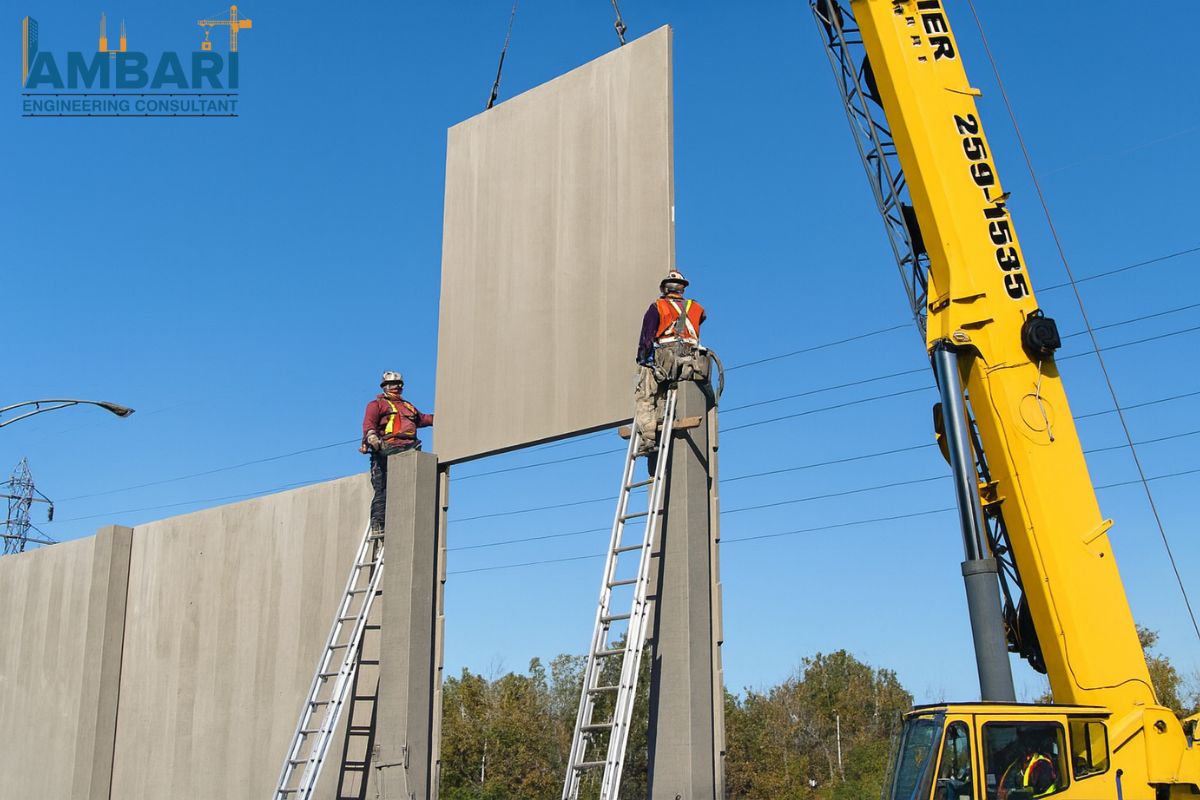
Pre-cast elements are transported using cranes or trucks, with special handling to prevent damage.
-
Positioning and Lifting
Cranes lift and place the elements accurately while workers guide proper alignment and positioning.
-
Assembly and Fixing
Elements are connected using bolts, welds, or grout. All connections are checked for stability and safety.
-
Final Inspection
After installation, elements are inspected for alignment, level, and structural soundness to ensure long-term safety.
Benefits of using pre-cast concrete
- Quickness of Construction: Pre-cast elements can be manufactured while foundations are being prepared.
- Quality Control: Factory-controlled production ensures consistent quality.
- Durability: Pre-cast concrete is strong and long-lasting.
- Lower Labor Costs: Less on-site labor is required.
- Flexibility: Suitable for a wide variety of construction structures.
Conclusion
Precast concrete has revolutionized the construction industry in the contemporary world by providing efficient, durable, and high-quality solutions. From the attentive production of products to the accurate installation, each measure is safe and reliable. Structural engineering, drafting and detailing, and steel detailing services in Vadodara play a crucial role in facilitating the design and construction of precast structures.
However, knowing about the manufacturing and installation process of precast concrete, builders and clients will make a wise choice and have an opportunity to construct faster without damaging the quality. The fact that production is factory controlled and installation is done by professionals guarantees a structure that passes the test of time
Frequently Asked Questions
-
What is pre-cast concrete?
Pre-cast concrete is concrete that is cast and cured in a factory and then installed on-site.
-
How is pre-cast concrete manufactured?
It is produced by mixing, reinforcing, pouring, compacting, and curing concrete in molds.
-
What types of pre-cast concrete elements exist?
Common elements include beams, columns, slabs, wall panels, and staircases.
-
What are the benefits of pre-cast concrete?
It provides durability, faster construction, quality control, reduced labor, and design flexibility.
.png)