.png)

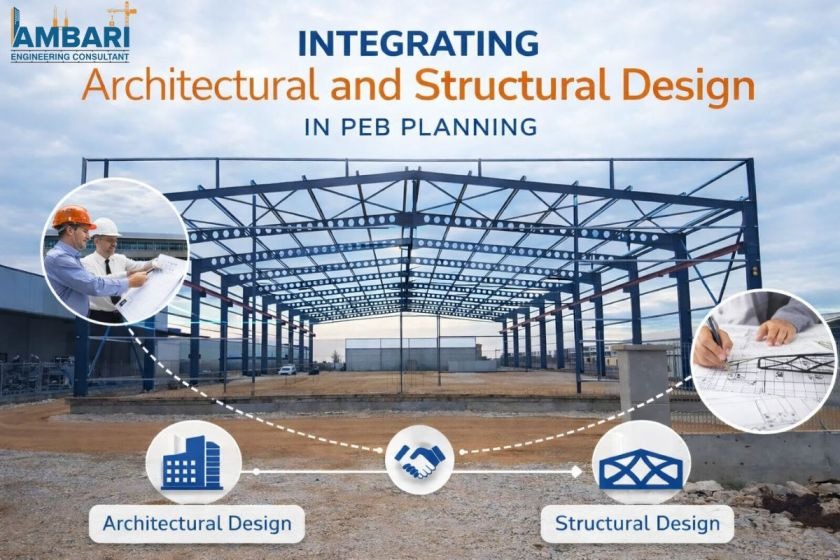
The incorporation of architectural and structural design in PEB planning implies that both teams collaborate at the initial stages to develop a building that is robust, practical, and aesthetically well balanced. Early alignment of PEB design and detailing services in India helps to make projects faster, safer, and less expensive and reduces design conflicts in the future.
However, integration does not involve guesswork. It makes sure that the appearance of a building and its standing are not thought of as two different concepts but as a single system.
In pre-engineered buildings, all the aspects are related. Columns, beams, roof slopes, wall panels, and openings influence each other. When architecture and structure are designed independently, the issues emerge during fabrication or construction.
Integration is, hence, not a choice but a need. By working together at the initial stages, architects and structural engineers can:
Additionally, integrated planning aids clients in having a clear idea of what they are receiving. An Ambari consultant often focuses on this teamwork to prevent surprises and design changes at the last minute.
Early integration implies that decisions are made in a fully technical way. Rather than planning and addressing issues at a later stage, teams resolve issues during the planning process.
This is where real structural behavior is compared to the architectural intent. This involves span lengths, bay spacing, roof slopes, crane loads, and expansion requirements.
Consequently, early coordination assists in:
Such decisions are more credible when the experienced structural engineering services in India guide the projects. Therefore, concept stage structural inputs make the building perform well in the actual site conditions like wind, seismic forces, and operational loads.
It is believed that structure restrains architecture by many people. But in PEB planning, architectural flexibility is in fact enhanced by clarity in structure.
The better layouts, facades, and internal spaces that architects design without jeopardizing stability are possible when they have a clear understanding of the structural grid and load paths. Structural clarity allows the following:
Furthermore, in collaboration with pre-engineered building manufacturers in India, integrated planning makes sure that architectural ideas are realistic to make and carry out. It is this creative and constructability balance that makes a PEB project successful.
Cost control is one of the greatest benefits of a combination of architectural and structural design. The needless use of materials and redesigning is reduced when the two teams collaborate.
Integrated planning assists in minimizing:
Moreover, the construction schedules are also enhanced since the drawings are synchronized. The number of conflicts between shop drawings and site conditions is reduced. Ambari Consultant uses this combined approach to make the approvals easier and the implementation quicker without compromising quality.
This strategy creates trust, as seen by the client. Budgets are predictable, and milestones of a project are easier to meet.
Integration is most effective through experience. It is not sufficient to know technical knowledge. Teams need to know the impacts of design decisions on fabrication, logistics, and site erection.
Experienced consultants understand:
Integrated PEB planning also takes into account future growth, circulation, utilities, and land use when the architecture master planning service in India. This will make the building accommodate not only the current needs but also the future expansion plans.
Moreover, an Ambari consultant applies the practical site experience during the planning phase, which assists customers to prevent the frequent errors that are witnessed in the disjointed design processes.
The combination of architectural and structural design in the PEB planning produces efficient, safe, and future-ready buildings. By working together in the initial stages, clarity in design is enhanced, risks are minimized, and the implementation process becomes easier. However, through the professional advice of Ambari Consultant and good coordination with the help of PEB design and detailing services in India, integrated planning brings real value, long-term reliability, and confidence of the client in any PEB project.
Why is integration important in PEB planning?
It does not have any design conflicts and makes sure that structure and layout are working in harmony.
Does integration increase project cost?
No, it usually saves money by cutting down on rework and wastage of materials.
When should integration start in a PEB project?
It must start at the concept and planning itself.