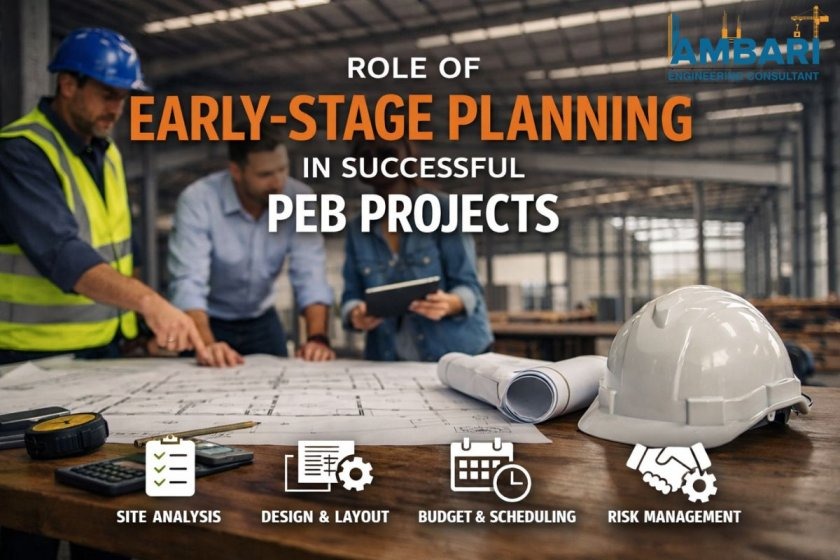
Role of Early-Stage Planning in Successful PEB Projects
Key Takeaways
- Planning done at the initial stages allows completing PEB projects on time and within budget.
- Precise design and detailing help avoid structural problems and construction delays.
- Working with manufacturers and fabricators improves project accuracy and efficiency.
- Early planning reduces risks and enhances quality, ensuring long-term building durability.
Pre-engineered buildings are factory-manufactured steel buildings, which can be customized, are durable, are cost-effective, and can be assembled very fast to be used in industries or for commercial or residential purposes. Pre-engineered buildings (PEB) have gained popularity among industries, warehouses, commercial areas, and even huge residential areas. They are very appealing due to their rapid construction, cost efficiency, and durability. Nevertheless, planning is one of the keys to the success of any PEB project.
Early planning helps the project to proceed to completion without any form of delays or overruns in costs. It could be layout, design, or details of structure, but whatever it is, proper planning at the beginning of the construction is the keystone to a robust, sound structure.
Additionally, engaging professionals like pre-engineered building manufacturers in India early in the process can be used to find the possible problems and give correct project estimates.
Understanding PEB Projects
A pre-engineered building (PEB) is a steel structure designed and manufactured in a factory, then transported to the site for assembly. These buildings are strong, versatile, and adaptable, making them suitable for a wide range of applications.
- Main frames and roof trusses
- Secondary framing members
- Wall and roof panels
- Bracing systems
Although the concept may seem simple, PEB projects can face cost overruns, schedule delays, and design conflicts if proper planning is not carried out at the initial stages.
Importance of Early-Stage Planning
Initial planning in PEB projects involves defining the project scope, budget, and schedule before construction begins. This stage sets the direction for the entire project and ensures smooth execution.
- Clear project objectives: Defining requirements early reduces the chances of design changes during construction.
- Cost control: Accurate budgeting helps minimize unexpected expenses and financial overruns.
- Time management: Timely material delivery and efficient assembly prevent project delays.
- Risk mitigation: Potential design, coordination, or site-related issues can be identified early.
Early-stage planning is not just a procedural step; it forms the foundation for the successful execution and long-term performance of a PEB project.
Key Steps in Early-Stage Planning
Early-stage planning in PEB projects must be well organized to ensure smooth execution. The following steps are essential for effective planning and successful project delivery.
-
Site Analysis
Assess soil conditions, topography, and site accessibility.
Finalize decisions on utilities, drainage, and local regulations.
-
Design Planning
Collaborate with specialists for PEB design and detailing services in India.
Define building dimensions, roof pitch, bay spacing, and load requirements.
-
Budget Estimation
Prepare detailed cost estimates covering fabrication, transportation, and on-site assembly.
Include contingency provisions for unforeseen changes.
-
Material Planning
Select suitable steel grades and roofing materials.
Schedule procurement in line with the project timeline.
-
Coordination with Fabricators
Engage PEB fabricators in India early to ensure accurate manufacturing.
Confirm fabrication aligns with approved designs and site requirements.
-
Approval and Compliance
Obtain required approvals from local authorities.
Ensure adherence to safety, quality, and environmental standards.
By following these structured steps, construction teams can minimize costly errors, improve coordination, and maintain a smooth workflow throughout the PEB project lifecycle.
Common Challenges Without Proper Planning
Failing to carry out early-stage planning in PEB projects can lead to several critical issues, including:
- Design conflicts: Structural and architectural elements may not align properly.
- Project delays: Late material delivery or incorrect construction sequencing can disrupt timelines.
- Cost overruns: Unplanned changes often result in increased project expenses.
- Safety risks: Inadequate planning can lead to unsafe structures or improper assembly practices.
Planning is therefore not an option but a necessity to ensure timely project delivery, cost efficiency, and safety throughout the construction process.
Benefits of Proper Early Planning in PEB Projects
When early-stage planning is carried out effectively in PEB projects, it delivers several key benefits that enhance overall project performance.
- Faster construction: Streamlined design and material preparation accelerate the assembly process.
- Reduced waste: Proper planning minimizes material wastage and on-site clutter.
- High-quality outcomes: Ensures structural integrity and compliance with applicable standards.
- Improved communication: Establishes clear coordination among clients, engineers, fabricators, and contractors.
Additionally, early planning supports sustainability by conserving resources and energy, reducing errors, and eliminating the need for rework.
Conclusion
Planning is an important part of any pre-engineered building project's success. It provides the basis of the project, minimizes risks, manages the costs, and ensures that the project is completed on time. However, the collaboration with such professionals as pre-engineered building manufacturers, PEB design and detailing services, and pre-engineered building fabrication in India coordination helps the project owners to have smooth operations and long-term outcomes.
Finally, the time and effort spent in the planning phase is justified in producing a quality, efficient, and successful PEB project. Planning is not an option; it is the secret of success.
Frequently Asked Questions
-
What is early-stage planning in PEB projects?
Early planning defines the project scope, budget, and design before construction begins to ensure a smooth execution.
-
Why is early planning important for PEB projects?
It reduces time delays, controls costs, and improves safety, efficiency, and overall project quality.
-
Who should be involved in early-stage PEB planning?
Clients, engineers, designers, and pre-engineered building manufacturers should collaborate closely during planning.
-
What happens if early planning is ignored in PEB projects?
Lack of early planning can result in delays, cost overruns, design conflicts, and increased safety risks.
.png)