.jpeg)
Roof, Wall, and Bay Spacing Optimization in PEB Structures
Key takeaways
- Appropriate spacing of roof, wall, and bay provides increased strength and safety for a PEB.
- Such optimized spaces will not only be helpful in minimizing the consumption of materials but also in managing the total amount of construction cost.
- Well-designed spacings can result in improved energy efficiency and reduced maintenance requirements.
- Proper planning ensures improved performance, long life, and quick project completion.
PEB buildings are prefabricated steel structures that are intended to be constructed within a short time, economical, and flexible in layout to suit various industrial applications. Pre-engineered buildings (PEB) are gaining popularity in the construction of industrial, commercial, and warehouse buildings in India. They are quicker to build, less expensive, and flexible in design.
Additionally, the effectiveness of a PEB structure, however, is greatly determined by the way the roof, wall, and bay spacing are designed. The maximization of these factors guarantees structural stability, cost-efficiency, and durability. However, this blog will discuss the reasons you should optimize the roof, wall, and bay spacing to improve the performance of your building and explain why you need to engage professionals who provide PEB design and detailing services in India.
Understanding PEB structures
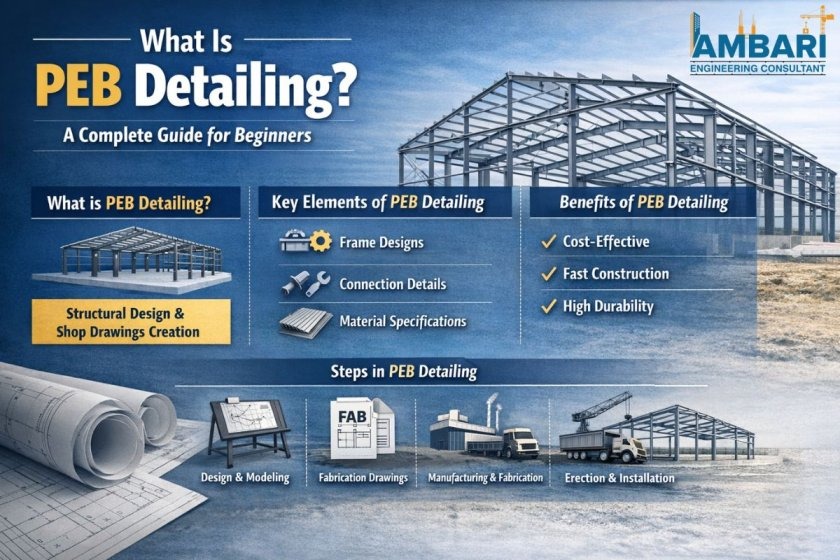
A pre-engineered structure is a construction that is created in a factory and assembled at the site. It comprises primary and secondary framing, roof systems, wall panels, and accessories. PEB structures are popular due to the fact that they are
- Quick to erect
- Cost-efficient
- Flexible in terms of layout.
- Low maintenance
Nevertheless, roof, wall, and bay spacing largely determine the performance of these buildings, and optimization is therefore very important.
Importance of roof, wall, and bay spacing optimization
Optimizing spacing is not just about appearance—it directly affects structural safety, material usage, and functional efficiency.
Roof spacing ensures roof panels can handle wind, rain, and load conditions without deformation.
Wall spacing prevents cracks, leakage, and insulation loss while improving thermal performance.
Bay spacing determines load distribution and overall building stability.
- Higher construction costs due to material wastage
- Frequent maintenance issues
- Reduced structural performance
Proper spacing optimization is therefore a cost-effective safety strategy.
Factors affecting roof, wall, and bay spacing
There are a number of considerations that affect the optimal distance in PEB structures. Knowledge of these can inform builders and engineers to make superior decisions:
- Building Size and Design: Bigger buildings might need broader bays in order to use material effectively and optimize the use of internal space.
- Load Requirements: Roof and wall panels should be able to bear dead loads, live loads, and environmental loads. Load calculation influences the spacing.
- Material Type: Steel grade, panel thickness, and roofing type determine the span capability of structural elements.
- Environmental Conditions: The roof pitch, wall support, and bay distance are influenced by the wind speed, rainfall, and seismic activity.
- Function of Building: Warehouses, factories, and office buildings vary in the spacing requirements depending on the equipment, storage, or human beings.
Furthermore, these factors can be properly analyzed and recommended in relation to the best spacing for long-term performance by professional services such as structural engineering services in India.
Techniques for optimization
The process of optimization of the roof, wall, and bay spacing involves the combination of engineering knowledge, software, and experience. The popular methods are as follows:
- Load Analysis: It involves the calculation of dead, live, wind, and snow loads in order to establish safe spans of roof and wall panels.
- Software Simulation: This involves design software testing in order to test various spacing conditions prior to real construction.
- Standardization: Following standard spacing requirements as given by PEB manufacturers to minimize errors and waste.
- Incremental Adjustments: Making small adjustments to the bay or roof spacing to enhance the distribution of loads without raising the cost.
- Cost Estimation: The cost of the material and labor would be estimated to determine the most cost-effective solution, which in this case would be pre-engineered building estimation in India.
Moreover, using these methods, constructors can balance safety in construction, affordability, and construction convenience.
Benefits of optimized PEB design
Optimization of roof, wall, and bay spacing has several advantages for the building:
- Increased Structural Stability: Spacing is done properly to ensure that there is even distribution of load and minimizes chances of structural failure.
- Cost Efficiency: Optimization minimizes the waste of material, which saves on construction costs.
- Energy Efficiency: The correct wall spacing will provide an opportunity to be better insulated, which will lower the cost of heating and cooling.
- Minor Maintenance: Optimal spacing eliminates frequent problems such as leaks, cracks, and corrosion.
- Quicker Construction: It is possible to construct faster by using pre-established optimized spacing guidelines that save time on-site.
Therefore, by selecting trusted pre-engineered building manufacturers in India, these optimizations will be properly executed and will provide a long-term benefit to the project.
Conclusion
The optimization of roof, wall, and bay spacing is also important towards the success of PEB structures. It enhances strength and durability and assists in regulating the cost of construction and energy. Spacing should be well thought out; with the help of professionals who provide PEB design and detailing services in India, the building will be safer, more efficient, and easier to maintain in the long term.
Finally, an appropriate layout of roof, wall, and bay spacing is a way of making a simple pre-engineered structure a consistent, sustainable, and high-performance structure that achieves the project objectives in the long term.
Frequently asked questions
-
Why is bay spacing important in PEB structures?
Bay spacing affects how loads are distributed across the structure. Proper bay spacing improves stability, reduces material stress, and helps control construction costs while keeping the building safe and functional.
-
How does roof and wall spacing impact building performance?
The proper spacing of the roofs and walls can assist the structure to withstand wind, rain, and any other load. It also enhances insulation, minimizes maintenance problems, and extends the life of the building.
-
Can improper spacing increase project costs?
Yes, bad spacing design may cause an increase in material usage, structural problems, and repairs. Optimized spacing will prevent the unnecessary costs and will contribute to the improved cost management in the long run.
.png)