.png)

Speed, quality, and cost-effectiveness are more significant in the modern construction world than ever before. Constructors and developers are always seeking ways of saving time, cost, and durability. One of these methods is precast engineering, which is changing the way buildings are designed and built.
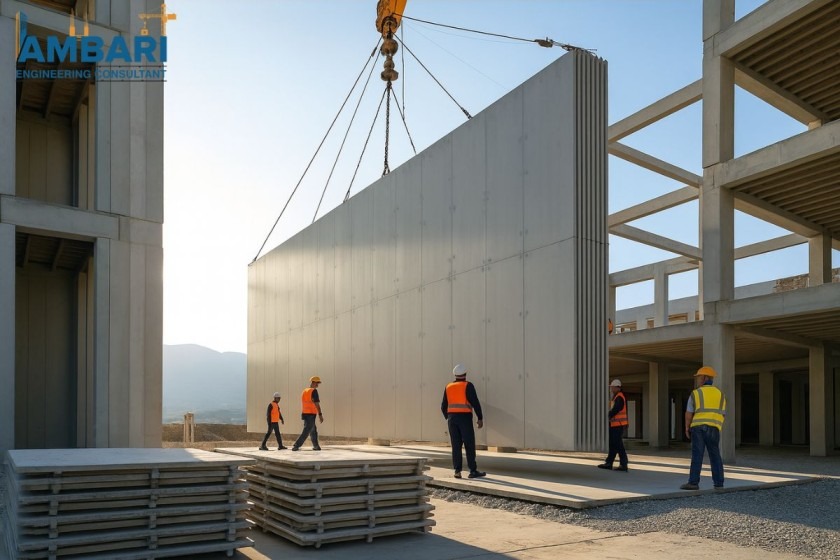
Rather than constructing everything on-site, components such as walls, slabs, and beams are fabricated in a factory where quality can be controlled accurately. However, these parts are then brought to the location and put together easily. This process minimizes errors and time and ensures a consistent quality. These benefits are leading to the popularity of precast engineering in the world, and even in India, construction projects are expanding at a high rate.
Pre-cast engineering is a type of construction whereby the building components are made in a regulated factory setting. These elements are made of concrete or steel and then transported to the construction site and assembled as per the project design.
Therefore, the point is to minimize the work on the site, preserve the quality, and accelerate the building process. Precast structures are standardized, unlike traditional constructions in which all the structures are constructed on-site. This standardization guarantees consistency of quality and durability.
Moreover, the approach contributes to the resources management and enables the minimization of the materials wastage and increases the predictability of the building process. Precast solutions are suggested by many professionals, such as an engineering consultant in Vadodara, in commercial, residential, and industrial projects. It makes construction easier, and at the same time, it has high structural standards.
Precast engineering has a number of advantages that make it a favorite in contemporary construction:
Furthermore, precast structures are easier to maintain. The damaged parts can be repaired or replaced within a short time as compared to the traditional construction, which might need a lot of work on the ground. This speed, quality, and durability combination is very appealing to developers of precast engineering.
Ready-made elements are universal and apply to a diverse variety of projects:
The need for such constructions is also increasing, and the firms that provide prefabricated building construction in India are growing to cater to the demand. Moreover, an adequate planning process known as pre-engineered building estimation in India assists clients to know the cost better and prevent unwarranted expenses. This not only makes precast engineering faster, but it is also economically predictable.
There are a number of reasons why precast engineering is becoming popular:
Additionally, precast construction eliminates the need to have skilled workers on the site. This is a significant benefit in regions where there is a shortage of skilled construction workers. Therefore, precast engineering is practical and strategically advantageous to contemporary infrastructure and building projects.
Pre-Cast Engineering is transforming the construction industry by providing a quicker, surer, and more economical alternative to the conventional approaches. It provides accuracy, reliability, and quality in commercial structures, industrial establishments, and infrastructure projects.
Furthermore, with the supply of pre-engineered building fabrication in India, professional guidance of engineering consultants in Vadodara, and correct pre-engineered building estimation in India, precast construction will become even more popular in the next few years.
Precast engineering provides intelligent, sustainable, and reliable solutions to developers, architects, and project managers. However, the fact that it is growing in popularity underscores the transition to the modern construction methodology that focuses on speed, precision, and cost-effectiveness and produces powerful and durable buildings.
Precast engineering is the process of producing building parts in a factory and fitting them at the site at an efficient rate.
It is providing quicker construction, uniform quality, saving of costs, durability, and environmentally friendly construction.
Precast structures are time-saving, require less labor, have less wastage, have quality assurance, and are very durable.
It is applied in commercial, residential, and industrial buildings; bridges; flyovers; and other infrastructural projects.
Precast engineering enables proper budget planning, low wastage, and accurate calculation of material usage.